Online sheet music converter, editor, and transposer
Online Sheet Music Converter, Editor & Transposer
MusicXML Sheet Music Workspace connects score scanning, staff and Jianpu conversion, transposition, correction, practice playback, and export around MusicXML and Score JSON.
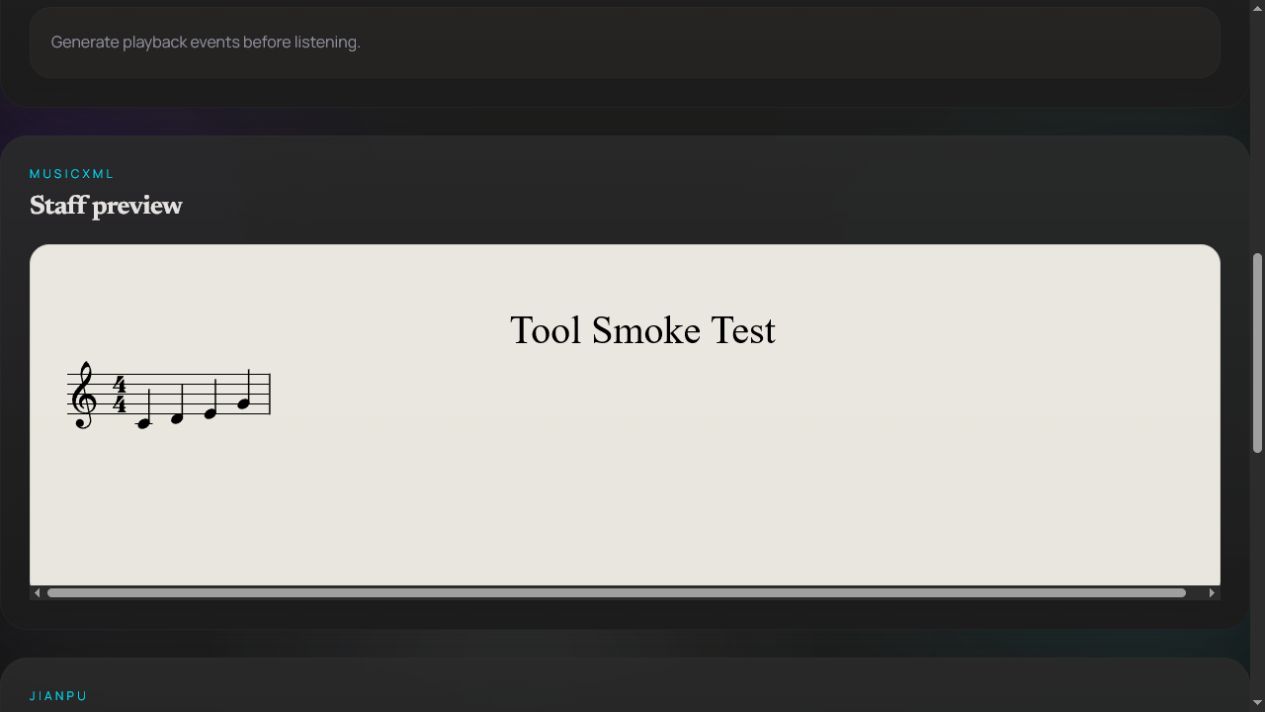
Clear PDFs can move into candidate review. Lower-confidence symbols and measures retain diagnostics instead of becoming accepted revisions without confirmation.
Definition snippet
What is a staff PDF to Jianpu converter? This is the short answer a search visitor should see first.
If someone arrives from staff PDF to Jianpu or numbered-notation searches, the answer is direct: a scan becomes a reviewable structured candidate that can continue into Jianpu, transposition, editing, practice, and export.
What an upload creates
A PDF or image becomes a reviewable MusicXML candidate. Once accepted, it is stored as a Score JSON revision for Jianpu conversion, transposition, playback, and export.
Why the PDF is not edited directly
PDF and image files remain import sources. Durable editing, transposition, playback, and export operate on structured notation rather than page pixels.
Current product limits
Complex-score recognition still requires human review. Desktop-grade engraving, high-quality instruments, and audio transcription also depend on notation complexity and configured server tools.
Core capabilities
One structured score connects recognition, correction, conversion, practice, and export.
Every workflow returns to the same MusicXML and Score JSON project instead of sending user files through disconnected one-off converters.
Only market what is already live
The site leads with staff PDF to Jianpu while also documenting structured imports, Jianpu round trips, transposition, correction, practice playback, and exports. Experimental and externally powered features are labeled clearly.
Search pages connect to the real product
Each feature page opens its matching score-project workflow. Capabilities that have not passed production verification show launch status instead of a broken entry point.
Draft-first when confidence is weak
Low-confidence pages stay in a safer draft package instead of being dressed up as a polished final export.
Platform feature pages
From one conversion entry point into a full score-project workflow.
These pages catch scanner, Jianpu, transposition, editing, playback, MusicXML/MIDI, teaching, and access intent, then route visitors back into the same Score JSON / MusicXML project model.
Deliverables
What a staff PDF upload creates: a review candidate, an accepted revision, and derived exports.
Source files, recognition candidates, accepted Score JSON revisions, and export assets remain separate so failed recognition cannot replace accepted work.
Preview layer
Jianpu snippet
Lets users inspect the direction of the recognition before trusting a full deliverable.
Final output
PDF export
Only promoted when the current heuristic chain is strong enough to justify a final result.
Safety fallback
Draft bundle
Keeps the job usable even when the source PDF is noisy, complex, or only partially recoverable.
Launch fit
Good for a controlled release, not yet for every notation scenario.
Pre-qualifying expectations on the site is cheaper than explaining the gaps after payment.
Users already have relatively clean five-line staff PDFs.
They accept a final manual review after export.
They want a faster route into teaching, rehearsal, or internal circulation materials.
Desktop-grade free-form engraving and complex layout repair.
Production OMR and audio transcription when external engines are not configured.
Very poor scans or highly complex pages that expect one-click publication-ready output.
Use cases
Who needs a staff PDF to Jianpu or numbered-notation converter most
The page is written for people who already understand score-processing tradeoffs and are specifically looking for a practical route from five-line staff into Jianpu.
Turn existing staff PDFs into Jianpu-first teaching handouts without rewriting the same arrangement manually.
Keep one score source while generating numbered notation for players who move faster with Jianpu.
Use a draft-safe output path to isolate the pages that still need human cleanup.
Product surface
The public website and the app now share the same vocabulary and visual tone.
Marketing and product now share one naming system, one interaction tone, and one visual hierarchy, so the transition from search traffic into the tool feels more intentional.
From visit to delivery
How to convert a five-line staff PDF into usable Jianpu in four steps.
Import a structured score or scan source
Start with MusicXML, MIDI, Jianpu text, or Score JSON. PDF and image OMR becomes available after Audiveris passes production verification.
Review the score candidate
Recognition output stays a candidate revision until the source image, confidence data, and flagged measures have been checked.
Edit, convert, and transpose
Correct notation, convert between staff and Jianpu, transpose, and configure practice from the same Score JSON project.
Play and export
After final human review, export MusicXML, MIDI, PDF, WAV, or MP3 according to the capabilities verified in production.
Pricing and activation
Open discovery, checkout access, and activation-based use for a staff PDF to Jianpu tool.
That preserves search visibility for the landing page while keeping the actual transaction and entitlement logic inside checkout and the app, without turning the marketing site into a backend console.
Public site
Open access
Readable without login so visitors and search engines can discover the offer.
Activation path
Pay / redeem
International users can pay online while mainland-China users can continue on activation codes.
Access term
1 year
The current payment and activation flow is positioned around one year of access.
Current commercial structure
Open discovery layer
The public site stays readable without login, which supports search indexing, brand explanation, and expectation setting.
Paid access layer
Actual tool access still comes from checkout completion or activation-code redemption, so the marketing site does not need to become a business console.
FAQ
Staff PDF to Jianpu FAQ before a buyer reaches support.
What is actually live right now?
The platform now includes score projects, MusicXML/MIDI/Jianpu imports, staff and Jianpu views, transposition, structured correction, practice playback, and core exports. OMR, high-quality rendering, and audio transcription depend on configured server tools and remain review-first workflows.
Do users need an account first?
The public site is open without login. International checkout can begin from the website, while activation redemption, uploads, and job history still live inside the app.
What happens when a PDF is unclear?
The pipeline can keep the job in a draft-safe bundle with preview text and diagnostics instead of pretending the result is ready for publication.
Does this support mainland-China customers?
Yes. The website can stay public and bilingual while mainland-China sales continue through activation codes and your existing commerce workflow.
Can I convert a staff PDF to Jianpu online here?
Yes, that is the core live scope of this release: upload a five-line staff PDF, run the conversion workflow, and receive either a promoted result or a draft-safe bundle.
Is this the same as a numbered notation converter?
In the current release, yes. If you are searching for a numbered notation converter, staff notation to Jianpu, or staff PDF to numbered notation, this website is describing that same practical workflow.
Delivery logic
Final when strong, draft when uncertain.
Input
Current source type in production.
Direction
Structured round trip
Staff notation, Jianpu, MusicXML, and Score JSON share one project model.
Fallback
Draft bundle
A safer downloadable package when confidence is not strong enough for final promotion.
Search intent
Staff PDF to Jianpu, five-line staff to Jianpu, and numbered-notation converter: the main landing-page intent.
That gives search users clearer landing-page context when they are looking for a staff PDF to Jianpu workflow, a numbered notation converter, staff notation to numbered notation, or a practical route from five-line staff into Jianpu.
What staff PDF to Jianpu means on this site
On this release, staff PDF to Jianpu means importing an existing five-line staff PDF and receiving usable numbered-notation output, preview text, or a draft-safe bundle for review.
Keyword variants that map to the same workflow
Users may search for staff PDF to Jianpu, staff notation to numbered notation, numbered notation converter, music score converter, or five-line staff to Jianpu. On this site, those searches map to the same practical workflow.
Why the wording stays narrow
The homepage keeps staff PDF to Jianpu as its primary search intent, while dedicated pages explain transposition, editing, playback, scanning, and teaching without mixing every workflow into one keyword cluster.
Keyword coverage
The landing page now covers the main staff PDF to Jianpu keyword clusters without turning spammy.
Primary term
Staff PDF to Jianpu
Used when the searcher already understands the destination format and wants a direct workflow.
Equivalent term
Five-line staff to Jianpu
Useful when users search with simpler or more literal phrasing.
Related intent
Numbered notation converter
Catches adjacent search intent from users who think in terms of numbered notation rather than Jianpu.
Privacy
The launch privacy story is now clear enough for a real public site.
Uploaded PDFs are used to run the requested workflow, retain source and result files, and support later download, review, and support investigation.
The privacy page now covers account identity data, uploaded files, generated outputs, support records, and the current manual deletion flow.
Before launch, the main remaining task is simply to keep the published copy aligned with the support and storage process you actually run.
Terms
State the service boundary, review responsibility, and delivery limits before payment.
That helps customers buy a clearly defined present-day capability instead of a fuzzy future roadmap.
The current terms already define service scope, draft-result expectations, refund boundaries, and acceptable use for uploaded material.
As long as your payment, activation, and support operations continue to follow those rules, the website content is already strong enough for a public launch.