Platform modules
Built on MusicXML and Score JSON
Each feature page maps back to the same score project model rather than a separate one-off converter.
Module
Score JSON transposition
Connected to the score project workflow.
Module
Target-key mode
Connected to the score project workflow.
Module
Instrument profiles
Connected to the score project workflow.
Module
Range diagnostics
Connected to the score project workflow.
Real product example
One score, structured input and reusable output
Captured from the running score project workspace and revision workflow. Captured 2026-07-15.
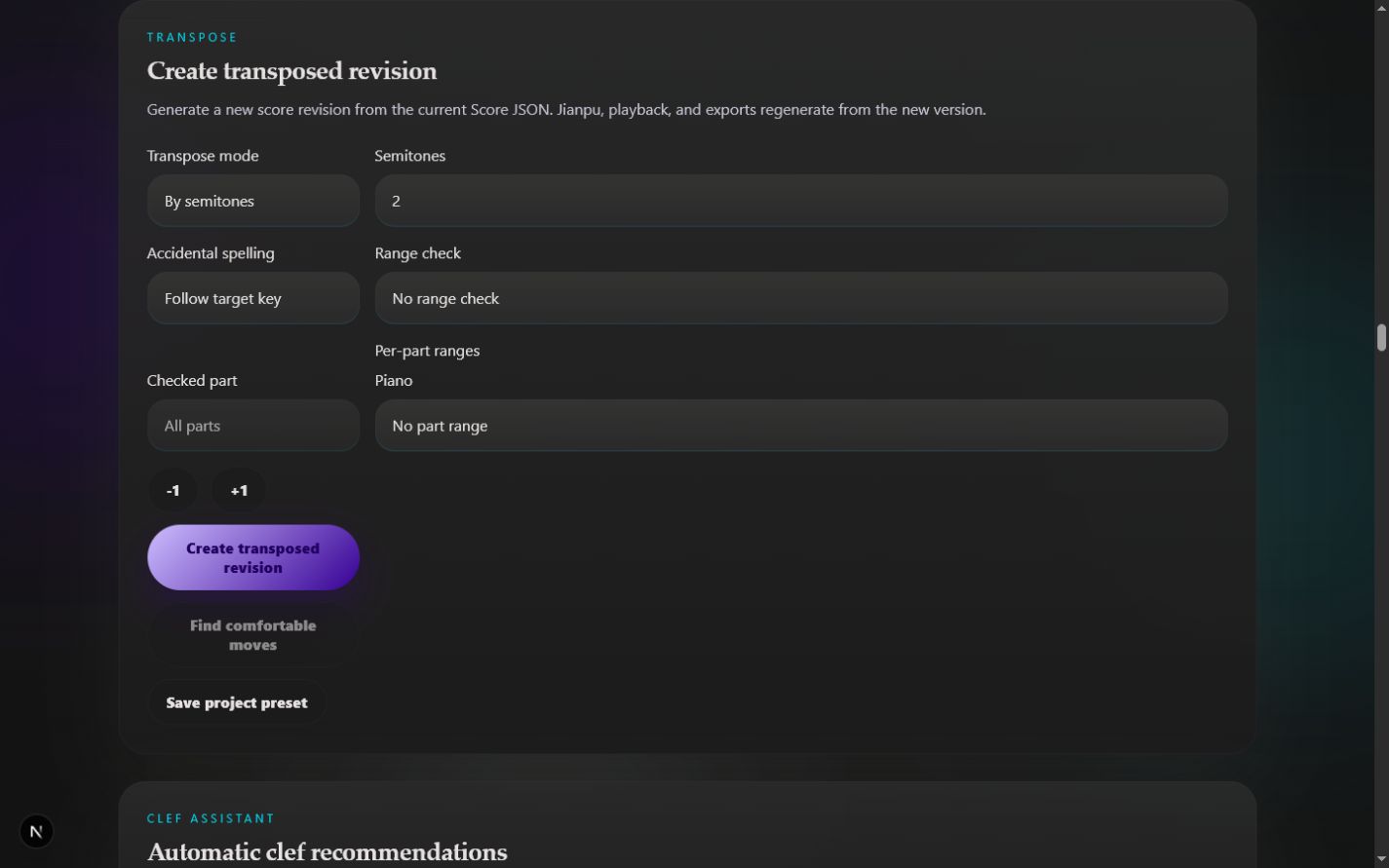
The current implementation supports semitone, target-key and transposing-instrument modes.
Workflow
How this path works
The public page leads into the authenticated app workflow when users are ready to process a score.
Open a score project
Use any project with a current Score JSON revision created from MusicXML, OMR, Jianpu, MIDI, or Score JSON import.
Choose the transposition mode
Move by semitones, choose a target key, or create a written part for Bb, A, Eb, or F instruments.
Check the resulting range
Optional voice and instrument range profiles report low/high notes and write warnings into the new revision.
Product detail
What to expect
Revision-based workflow
Exports regenerate from the model
FAQ
Questions about Transpose sheet music online
Practical limits and expected workflow for this score tool.
What input does Transpose sheet music online accept?
Use any project with a current Score JSON revision created from MusicXML, OMR, Jianpu, MIDI, or Score JSON import.
Can I edit the result after conversion?
Yes. Successful imports become Score JSON revisions that can be corrected, transposed, played, and exported from the score workspace.
What should I check before relying on the result?
Transposition uses music21 when configured and keeps a deterministic TypeScript fallback; complex enharmonic spelling and clef comfort still require review.
Related workflows
Continue with the same score project
These pages use the same MusicXML and Score JSON source instead of sending the score through disconnected converters.